Monday, April 23, 2018

Magnet talk


One of my kids, probably encouraged by his siblings, once gave me a magnet, which said (says, it still lives on my fridge) “Everybody is entitled to my Opinion”.  Needless to say that my Opinion on the matter under hand was given on the spot, from which both object and objector have since recovered nicely.
All this to say that when it comes to art, everybody is, of course, entitled to their Opinion. But when you’re a budding artist, self-conscious and unsure, everybody’s Opinion can become the source of doubts and nightmares and doubts again. I started painting late in life and found the courage to show my work to professionals even later. That proved to be both an exhilarating and tormenting experience.
My teacher and mentor, Georges Faget-BĂ©nard, often says “il ne passe personne dans ton placard”, which sounds sexy but really translates into “nobody gets to see the inside of your closet”.  Or in other words, get out there and show your work, girl! So go out did I and, oh boy! did I get Opinions!
Galleries I shyly approached with my portfolio politely informed me that they were swamped with requests, that we were too big a number of wannabe artists to actually fit into their schedule, that the latter was only available to “recognizable” artists, that the realistic style of painting has passed to never return, that only  “displays” (you know, a pair of army boots without laces in the middle of a huge, empty room?)  could be considered Art, that I should learn to paint, that the market was flooded….
From those Opinions I have managed to recover. As, I am sure, most budding artists have and will. I do approach a gallery from time to time and, even more seldom, enter a competition.  And, although refusals are never fun to receive, they make the rare favorable Opinions so much more delightful and encouraging. So, if you’re an artist and still in the closet, open the door and push your work out there. That is My Opinion.

Monday, March 5, 2018

Alone with Hopper

Nighthawks, Edward Hopper, 1942, oil on canvas, 152,4x82,1cm
The Art Institute of Chicago, 


Some years ago, I visited a huge Parisian exhibition dedicated to Edward Hopper at the Grand Palais.
As always on those occasions, an amazing number of people lined up in layers, moving in parallel sliding, raucous ribbons alongside the walls where Hopper’s world was exposed for everyone to try to see. 
Seeing one Hopper painting can be a mystical experience. He does that thing he does with the light and shadow, warm and cold colors, that literally kidnaps the viewer into the frame. He tells the story of urban loneliness, of shyness and introversion.  He paints people in ones, twos and threes, in cafes and ordinary rooms where they sit or stand, always ignoring one another, preoccupied by something, whatever that may be. He paints a universe where the word communication has yet to be invented.
Seeing all those paintings aligned on white walls, depicting one after another lonely humans, is like eavesdropping on the man’s twice a week imaginary therapy session.  After all, didn’t he write:
“ Great art is the outward expression of an inner life in the artist, and this inner life will result in his personal vision of the world. No amount of skillful invention can replace the essential element of imagination.[1]
But seeing dozens of Hopper’s painting while being carried by a human river three person wide and four hundred person long is a sad experience indeed. The contrast between the imaginary loners and the living sardines fills the space that separates the many heads from the high ceiling of the Palais.
Roger Federer appearance in a painting "study after Edward Hopper's Nighthawks".
Nightfed, a study after Hopper, O/C, 120x67cm, on commission

Of course, most of us will never have a one to one meeting with Hopper. But I can’t help but envy those very, very privileged few who get to sit alone in their secret vaulted basement, cognac glass in one hand, cigar in the other (this is what you get from watching too many shows…) a Hopper painting – rightfully obtained, of course! – hanging on the opposite wood-paneled wall, museum lighting gracefully provided by the decorator.
What to do, then? Give up the great commercial asset that is Hopper and only organize exhibitions where, let’s be bold, 20 people at a time can be allowed to wander inside? Leave Hopper to his own museum or to dedicated places in national establishments, where tourists armed with smartphones will shoot selfies with Nighthawks behind their backs?
Obviously, sharing art with us, the People, plays on our modern illness of consumerism caracterized by no other motivation than that of possessing something, be it an hour with Hopper in an overstuffed space. And, yes, it requires a lot of self-discipline to truly appreciate Hopper’s art, or any other art for that matter, under those conditions.
But, hey, until someone buys me a Hopper for my birthday, it’s the best I can hope for.


[1] From“Statement”, submitted to the journal Reality in 1953.

Tuesday, February 27, 2018

One rainy day in London...

I admit, I didn't plan to see "Reflections: Van Eyck and the Pre-Raphaelites" exhibition in the National Gallery. 

I started out at the British Museum, where a lovely young lady whom I asked about their painting collection politely informed me that they only carried historical objects and artefacts and that I would be better off at the National Gallery or Tate Britain.
It was pouring outside, so National Gallery it was. 

                                                  
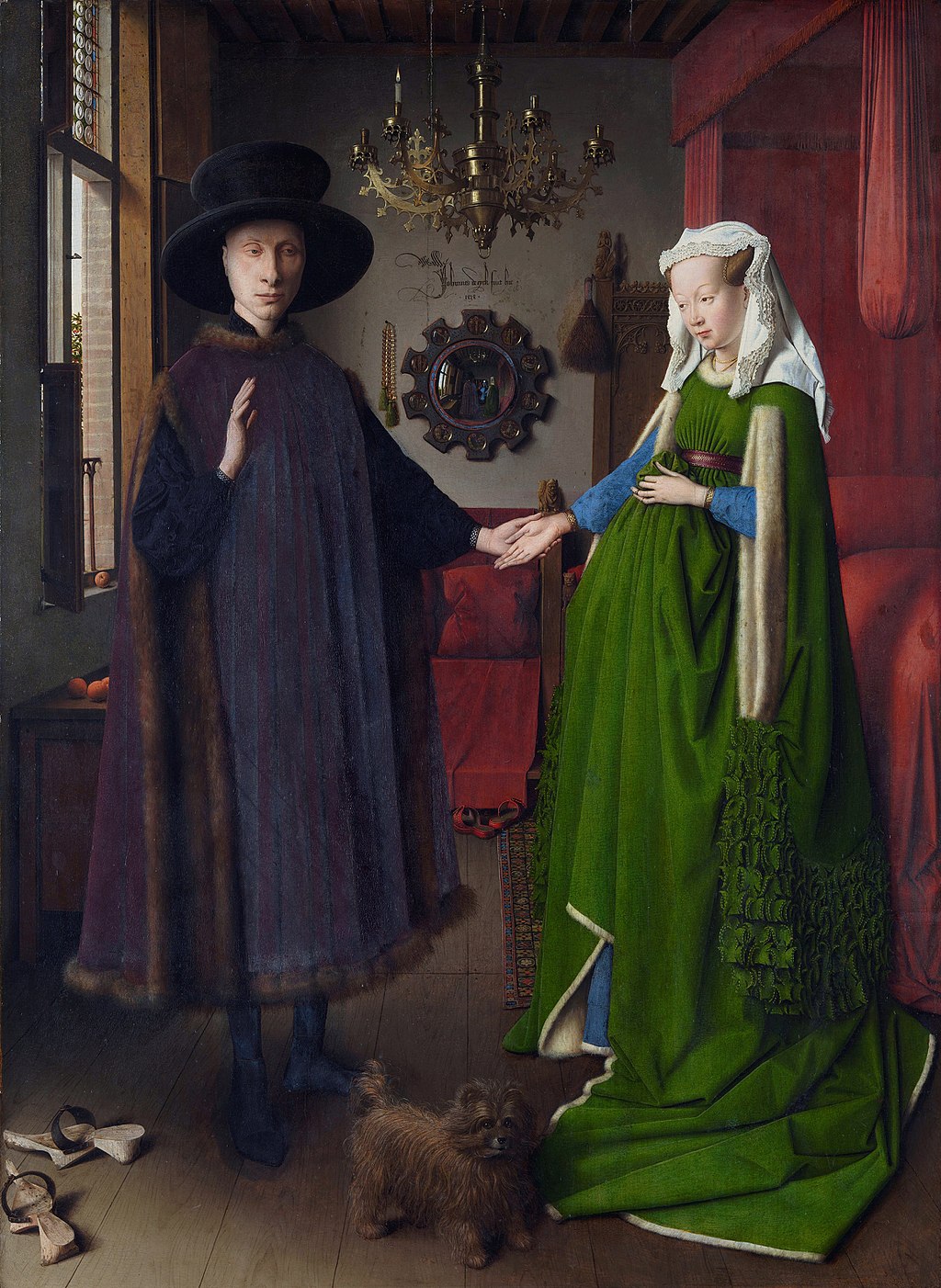
The Arnolfini Portrait, Jan van Eyck, 1434, oil on panel, 82x59,5cm, National Gallery, London

Jan Van Eyck being all realistic painters' guru and Pre-Raphaelites being a personal favorite brotherhood, my going through this exhibition could only be compared to a cat stumbling across a bowl of cream with all the time in the world to give it its full attention.
Not only was it rewarding to admire, once again, the mastering of the technique for which Old Masters and Pre-Raphaelites were known for. John Everett Millais's Mariana is, I am sure, both an inspiration and an impossible challenge for many of us. Or to experience the emotion those paintings inspire. John William Waterhouse's 1894 Lady of Shalott as well as Sidney Meteyard's portrait of Tennyson's tragic heroine have despair and romance oozing from every single brushstroke. 
But also was it great to feel the empowering these great artists still shower on us, stubborn painters of today who, day after day, continue painting realistically our very own world. 
Many a painter, critic or art lover question the legitimate foundation of painting things exactly as they are in our era. Why paint like a photo, they ask. Why on earth spend days, weeks, months even on a medium size canvas when every digital printing shop can produce a similar result for 9,95 in five seconds? 
Well, the answer is there, in this exhibition. Where every painting is rich with hidden treasures and clever symbols carefully staged by an outstanding artist.
We, realistic painters of today, from the modest anonymous to the celebrated ones, are grateful because thanks to those Masters, we can hold our head high and proclaim.
Yes, we paint trees as we see them, with trunks streaked with age and leaves that have veins. Yes, we paint portraits that look exactly (at least some of the good portrait painters do....) like their models. And when we paint still life, you can see the light reflected on the tiny pinpoint black grains that dot the red surface of the strawberries and the thinnest of lines the defines the rim of the wineglass.
But we do not, I repeat, do not, paint "like a photo". If you look closely, something in the play of light and shade will reflect the artist's mood. Some object, an innocent bystander in the composition, will symbolize the artist's beliefs, be they religious, political, philosophical or whatever chaos that goes on in his mind. Something in the trees will betray the artist's inner tempest. Something in the tones, hues and values - technical terms for the different elements that define what we call color - give away the artist's personality traits. And in the model's eyes, there always is something of the artist's soul. 
Those, and many other things, are only there for those who want to see them.


So, really, if you're in London, either living there or visiting, go to the National Gallery and enjoy your bowl of cream.


Reflections: Van Eyck and the Pre Raphaelites, National Gallery, London until April 2nd 2018.

https://www.nationalgallery.org.uk/whats-on/exhibitions/reflections-van-eyck-and-the-pre-raphaelites