I admit, I didn't plan to see
"Reflections: Van Eyck and the Pre-Raphaelites" exhibition in the
National Gallery.
I
started out at the British Museum, where a lovely young lady whom I asked
about their painting collection politely informed me that they only carried
historical objects and artefacts and that I would be better off at the National
Gallery or Tate Britain.
It
was pouring outside, so National Gallery it was.
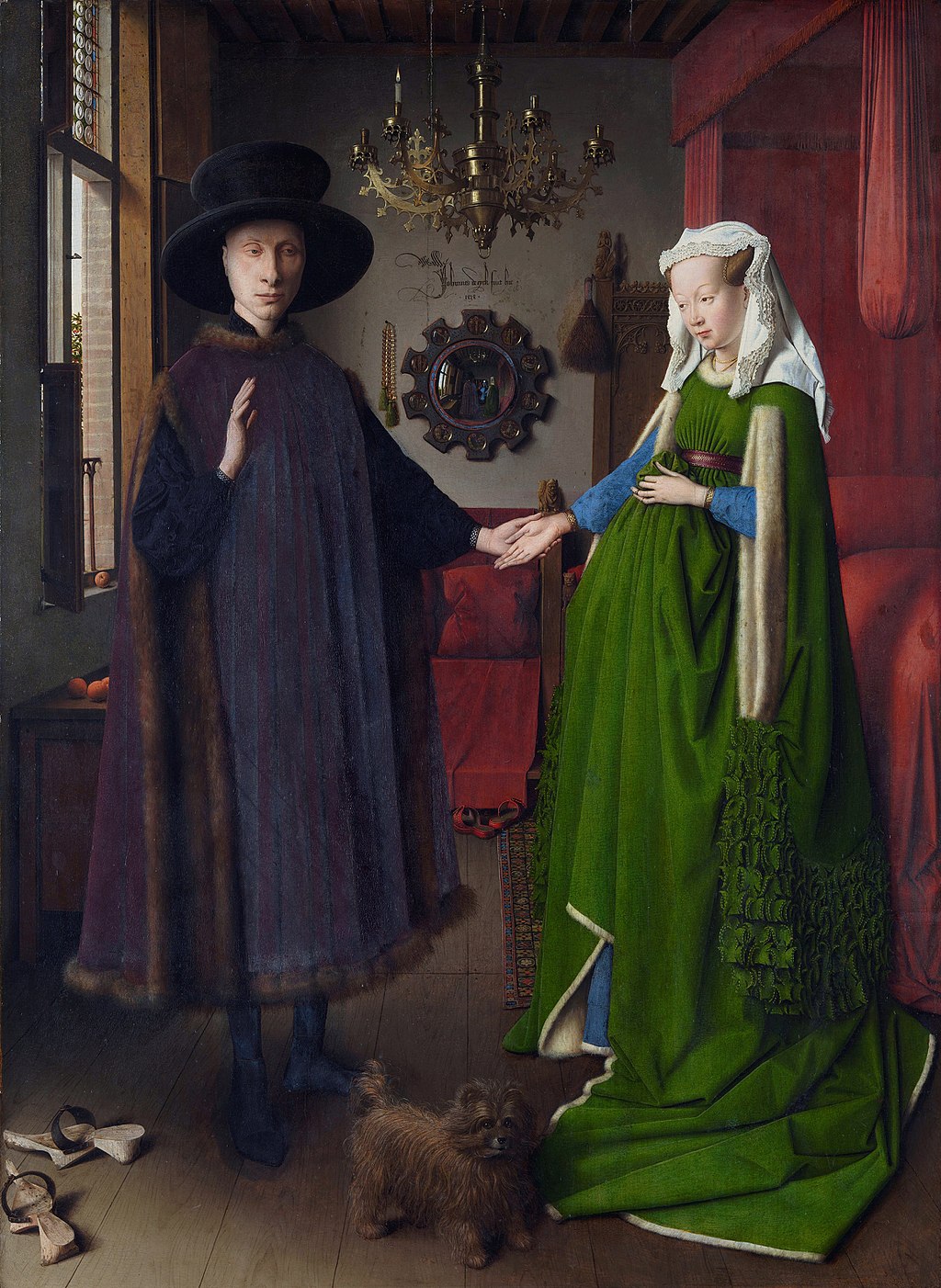
The Arnolfini Portrait, Jan van Eyck, 1434, oil on panel, 82x59,5cm, National Gallery, London
Jan Van Eyck being all realistic painters' guru and
Pre-Raphaelites being a personal favorite brotherhood, my going through this
exhibition could only be compared to a cat stumbling across a bowl of cream
with all the time in the world to give it its full attention.
Not only was it rewarding to admire, once again, the mastering
of the technique for which Old Masters and Pre-Raphaelites were known for. John
Everett Millais's Mariana is, I am sure, both an inspiration and an impossible
challenge for many of us. Or to experience the emotion those paintings inspire. John
William Waterhouse's 1894 Lady of Shalott as well as Sidney Meteyard's portrait
of Tennyson's tragic heroine have despair and romance oozing from every single
brushstroke.
But also was it great to feel the empowering these great artists still shower on us, stubborn painters
of today who, day after day, continue painting realistically our very own
world.
Many a painter, critic or art lover question the legitimate
foundation of painting things exactly as they are in our era. Why paint like a
photo, they ask. Why on earth spend days, weeks, months even on a medium size
canvas when every digital printing shop can produce a similar result for 9,95
in five seconds?
Well, the answer is there, in this exhibition. Where every
painting is rich with hidden treasures and clever symbols carefully staged by
an outstanding artist.
We, realistic painters of today, from the modest anonymous to the celebrated ones, are grateful because thanks to those Masters, we can hold our head high and proclaim.
We, realistic painters of today, from the modest anonymous to the celebrated ones, are grateful because thanks to those Masters, we can hold our head high and proclaim.
Yes, we paint trees as we see them, with trunks streaked with
age and leaves that have veins. Yes, we paint portraits that look exactly (at
least some of the good portrait painters do....) like their models. And when we
paint still life, you can see the light reflected on the tiny pinpoint black
grains that dot the red surface of the strawberries and the thinnest of lines
the defines the rim of the wineglass.
But we do not, I repeat, do not, paint "like a photo".
If you look closely, something in the play of light and shade will reflect the
artist's mood. Some object, an innocent bystander in the composition, will
symbolize the artist's beliefs, be they religious, political, philosophical or
whatever chaos that goes on in his mind. Something in the trees will betray the artist's
inner tempest. Something in the tones, hues and values - technical terms for
the different elements that define what we call color - give away the artist's
personality traits. And in the model's eyes, there always is something of the
artist's soul.
Those, and many other things, are only there for those who want
to see them.
So, really, if you're in London, either living there or
visiting, go to the National Gallery and enjoy your bowl of cream.
Reflections: Van Eyck and the Pre Raphaelites, National Gallery, London until April 2nd 2018.
https://www.nationalgallery.org.uk/whats-on/exhibitions/reflections-van-eyck-and-the-pre-raphaelites

No comments:
Post a Comment